*As a demonstration zone for achieving common prosperity, Zhejiang is leveraging its digital advantages to drive economic growth and deliver broader, more balanced gains.
*"The core of common prosperity is affluence and sharing. Simply put, it means expanding the economic 'pie' and distributing it fairly," said He Wenjiong, vice president of the Institute for Common Prosperity and Development at Zhejiang University.
*The approach reflects China's long-standing people-centered philosophy, which places human well-being -- rather than the maximization of capital returns -- at the heart of modernization. He added that as technology reshapes wealth creation and distribution, it is vital to use AI to enhance people's well-being and promote their comprehensive development.
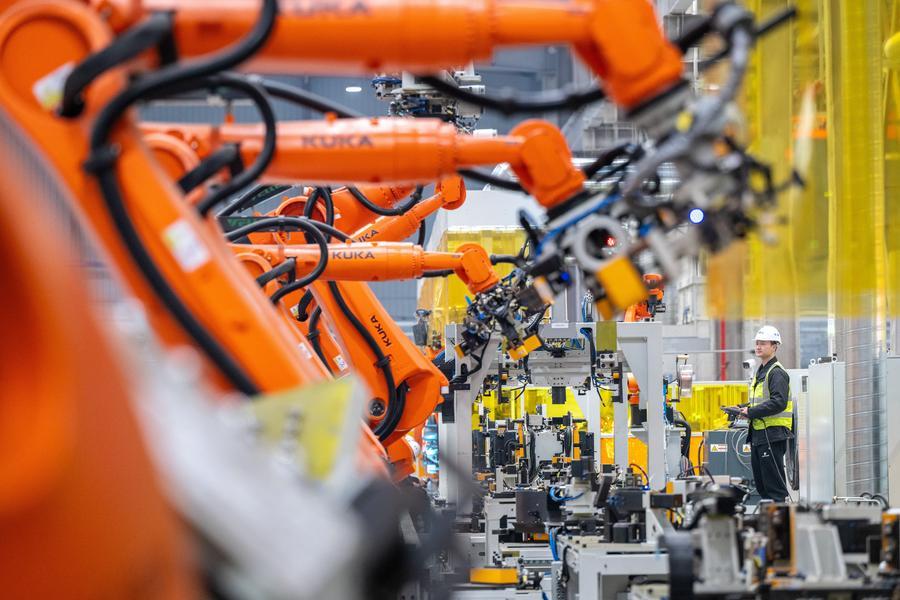
An employee works on the production line in a smart factory of Noblelift, a manufacturer and service provider of material handling equipment and logistics solutions, in Changxing County of Huzhou City, east China's Zhejiang Province, March 16, 2026. (Photo by Tan Yunfeng/Xinhua)
HANGZHOU, July 18 (Xinhua) -- Confined to a wheelchair after an accident seven years ago, Zhou Lanzhen, in her 50s, never imagined she would become a confident e-commerce livestreamer.
After receiving AI-powered e-commerce training in 2024, the woman from a mountain village in east China's Zhejiang Province runs a thriving online umbrella store. "Now I feel my life is full of promise," said Zhou, whose store has recorded up to 80,000 orders in a single day.
Zhou's success is far from an isolated case. In recent years, nearly 100,000 people in Zhejiang have participated in similar training programs, leveraging AI and digital technologies to build better lives.
This game-changing digital boom is rooted in Zhejiang's technological strengths. Home to tech giants like Alibaba and innovative startups such as DeepSeek and Unitree Robotics, the province is a hub for China's advanced manufacturing and digital economy.
As a demonstration zone for achieving common prosperity, Zhejiang is leveraging its digital advantages to drive economic growth and deliver broader, more balanced gains.
Contrary to some Western portrayals, common prosperity is not redistribution, nor a type of egalitarianism that suppresses market incentives. "The core of common prosperity is affluence and sharing. Simply put, it means expanding the economic 'pie' and distributing it fairly," said He Wenjiong, vice president of the Institute for Common Prosperity and Development at Zhejiang University.
The approach reflects China's long-standing people-centered philosophy, which places human well-being -- rather than the maximization of capital returns -- at the heart of modernization. He added that as technology reshapes wealth creation and distribution, it is vital to use AI to enhance people's well-being and promote their comprehensive development.
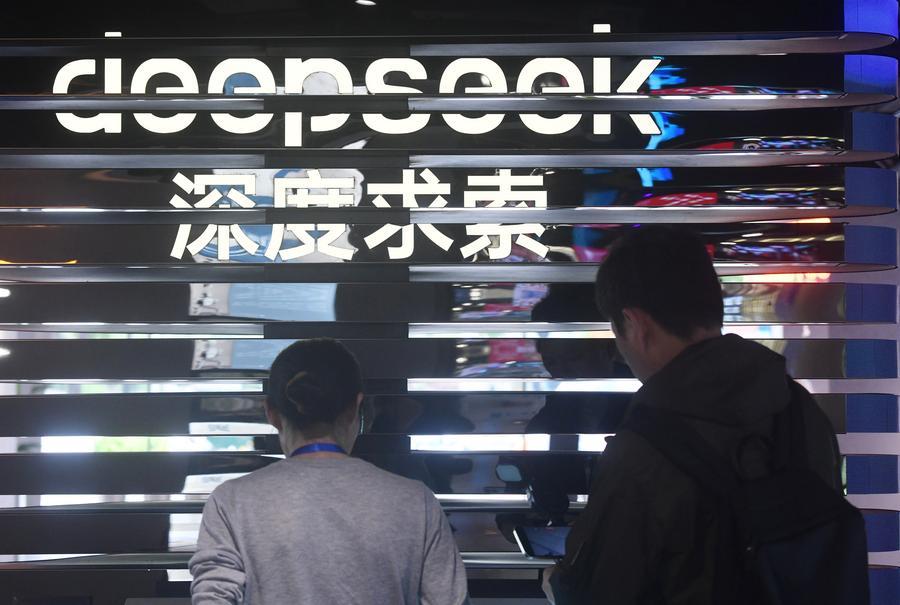
People learn about AI model DeepSeek at a fair themed on AI technologies in Hangzhou, east China's Zhejiang Province, May 4, 2025. (Photo by Long Wei/Xinhua)
EXPANDING ECONOMIC PIE
For Zhang Chen, in his 30s, AI has sparked an unexpected career transformation. Four years ago, he joined the base of LONGi Green Energy in Zhejiang's Jiaxing as a frontline quality inspector, relying on his eyes to spot defects on solar panel production lines.
As the factory accelerated its smart upgrade, pushing automation rates above 90 percent, Zhang transitioned to an AI trainer in 2023. He now feeds large language models with his years of inspection experience.
The AI models are applied across nine major procedures and 198 inspection items at the "lighthouse factory." Inside the factory, automated guided vehicles shuttle back and forth, and solar modules roll off the line every 16 seconds.
"Once the system flags a defect, human workers only need to double-check it. The labor cost in the inspection process has dropped to one-eighth of what it used to be," Zhang said.
"AI has given the factory an 'always-on intelligent brain'," said Weng Chengbin, deputy general manager of the LONGi Green Energy Zhejiang Base, noting that delivery cycles have been cut by more than 80 percent, generating over 62 million yuan (about 9.13 million U.S. dollars) in annual revenue for the company.
The company's AI upgrade epitomizes Zhejiang's broader push for high-quality development and its efforts to expand the economic "pie". Statistics show that the value added by the digital economy accounts for over 50 percent of the province's GDP, while the value added by its core industries has surpassed 1 trillion yuan.

Sun Lijuan displays product-selling videos in different language versions inside her shop at the Yiwu International Trade Market in Yiwu, east China's Zhejiang Province, May 21, 2025. (Photo by Tang Yanqing/Xinhua)
Boosting industrial output is just one facet of the province's digital transformation to drive economic growth. AI is a game-changer in local trading hubs, helping merchants expand their global reach.
In Zhejiang's Yiwu, known as the "world's supermarket" and home to the world's largest wholesale market for small commodities, over 30,000 merchants routinely use AI tools. Heavy users have seen their orders grow by more than 20 percent.
Sun Lijuan, who sells interactive smart dolls in Yiwu, is one of them. She uses AI to generate promotional videos in 36 languages, with lip-syncs adjusted to match local pronunciation. "Language is no longer a barrier," she said, noting that her clients now span Latin America and Belt and Road partner countries.
SHARING DIVIDENDS
Zhejiang, while home to major technology companies, is also a largely mountainous province. Locals often describe it as having "seven parts mountains, one part water, and two parts farmland."
For years, many women living in mountainous areas have faced narrow employment options due to a lack of skills and resources, said Zhou Danying, a member of the leading Party members group of the Yiwu Women's Federation.
To ensure the dividends of technology are shared by all, Zhejiang is bringing AI benefits to the grassroots level. Zhou added that AI tools and digital platforms are linking top merchants with rural workshops, creating new job opportunities.
Since early spring this year, orders for gift box packaging from Yiwu have kept pouring into the "women-oriented common prosperity workshop" in Yanghe Village of Zhejiang's Kaihua County.
"It is so convenient to work right at my doorstep. I can earn over 100 yuan a day, making it possible to take care of my family while boosting my income," said local villager Zhang Yanping.
Across the province, 4,000 similar workshops are creating jobs close to home. In 2025, they employed 136,000 women and helped 15,700 low-income individuals increase their earnings.
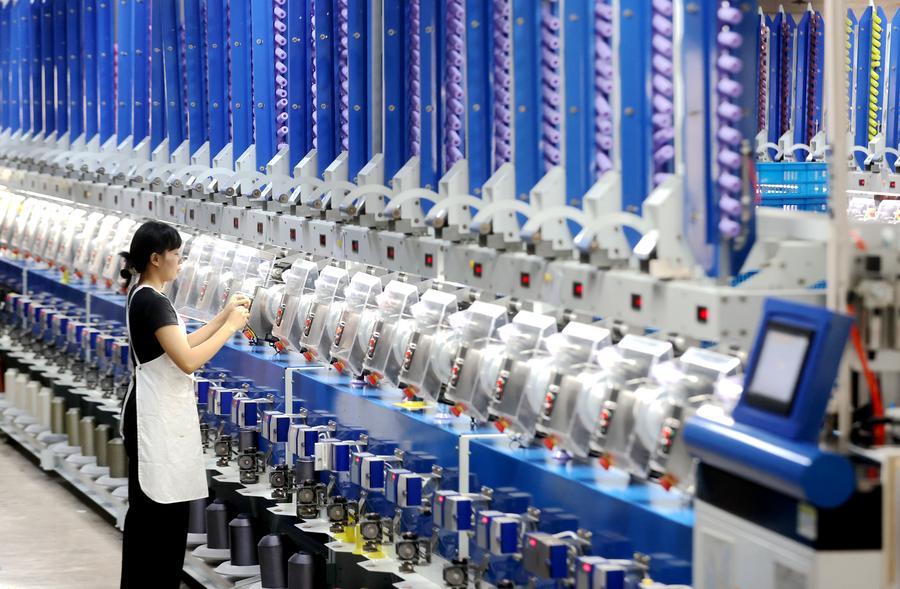
A worker checks automatic spool winders at a smart factory of a company in Xin'an Town of Deqing County, Huzhou City of east China's Zhejiang Province, June 15, 2026. (Photo by Xie Shangguo/Xinhua)
Beyond income generation, smart technologies are also bridging the educational divide in mountainous areas.
At Qixi Township Central School in Kaihua, fourth-grader Wang Xiaoxiao uses a tablet to interact with an AI-powered assistant known as "Qian Xiaowa," which helps them read classics and recite poems, and recommends materials tailored to their abilities and interests.
"The tablet is packed with books I've never read before. Whether it's Chinese texts or English stories, I can hear standard pronunciation with just a tap," Wang said.
Most students at the school are "left-behind children" raised by grandparents while their parents work elsewhere. For years, the school's library held only a few hundred books, many of them outdated or inappropriate for young readers, said Wang Wenhui, a teacher at the school.
The change began in late 2025, when a provincial public welfare project equipped small-scale schools with smart terminals. "This means rural children can enjoy the high-quality education as those in cities, starting on the same footing," said the teacher.
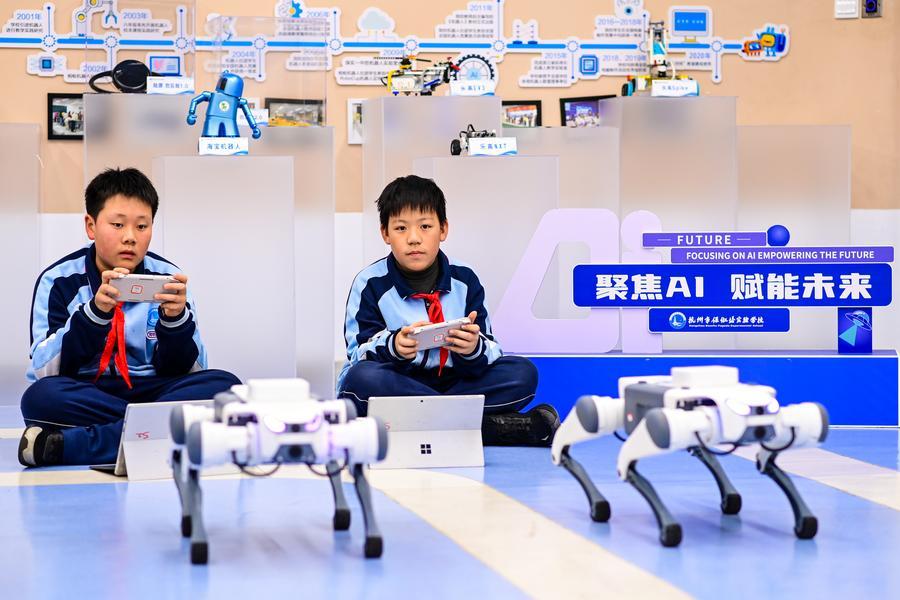
Students of Hangzhou Baochu Pagoda Experimental School learn to program robotic dogs during an AI course in Hangzhou, east China's Zhejiang Province, Dec. 2, 2025. (Xinhua/Jiang Han)
AI is also opening new career paths for students with special needs. At Hangzhou Yanglingzi School, autistic students are being trained as data annotators.
"Students with autism often excel in visual search and processing fine details, which aligns perfectly with the demands of data annotation," said Chen Yue, an IT teacher at the school, adding that the data annotation course has been running for nearly three years.
The school has partnered with tech companies and cultural institutions to provide internships. "We hope these students can contribute to AI infrastructure with their unique strengths and share in the digital dividends," Chen said.
While technology creates new wealth, observers call for proper governance to avoid potential widening inequality. "To ensure technology benefits everyone, we must build a social service system that prevents dividends from being monopolized," said He Wenjiong.
To sustain this momentum, Zhejiang has embedded tech-driven inclusion in its plans during the 15th Five-Year Plan (2026-2030) period. The province will also establish a public service system tailored to high-quality population development.

This photo taken on Feb. 28, 2026 shows humanoid robots of Unitree Robotics dancing at a square in Tonglu County, east China's Zhejiang Province. (Xinhua/Huang Zongzhi)
Since reform and opening-up began in the late 1970s, China has advanced common prosperity by allowing some regions and groups to prosper first, encouraging them to lift others along the way.
Far from dampening economic momentum, this approach has delivered parallel gains in both growth and inclusion. China has remained the world's second-largest economy for more than a decade while overall living standards have continued to rise. A major milestone came in 2021, when the country declared the eradication of absolute poverty.
Experts said China's major provincial-level economic powerhouses, including Zhejiang, are expected to take the lead in promoting common prosperity as they have better development foundations.
This trend aligns with China's long-term development agenda. In the outline of China's 15th Five-Year Plan, the country has pledged to make solid progress in "achieving common prosperity for all."
(Reporting by Ji Hang, Sun Tiexiang, Zhu Han, Duan Jingjing and Zheng Keyi; Video reporters: Li Tao, Zhu Han and Zhang Xuan; Video editors: Zhou Yang, Wei Yin and Zheng Qingbin.)
编辑:王瑜