
Combine harvesters harvest wheat in the field in Wudalianchi City, northeast China's Heilongjiang Province, Aug. 5, 2025. (Photo by Lu Wenxiang/Xinhua)
China's vision of building a community with a shared future for humanity proposes a logic of inclusion rather than exclusion, and win-win cooperation rather than a zero-sum game, said Emin Gasimov, director of Azerbaijan's Center for the Study of China's Global Initiatives, Development and Culture.
BAKU, March 30 (Xinhua) -- China's 15th Five-Year Plan is set to offer the world a package of new opportunities for win-win cooperation in such areas as industry, trade, digital economy and infrastructure, said Emin Gasimov, director of Azerbaijan's Center for the Study of China's Global Initiatives, Development and Culture.
During the recently concluded "two sessions," Chinese lawmakers have approved the outline of the 15th Five-Year Plan (2026-2030) for national economic and social development.
The document reinforces the global perception of China as a large-scale, resilient and tech-driven partner, capable of simultaneously opening markets, creating demand, driving innovation and providing effective institutional platforms, Gasimov said in a written interview with Xinhua.
He noted the plan's emphasis on increasing imports of advanced technical equipment, high-quality agricultural products and producer services.
"For other countries and regions, this means not only an expansion of exports to China but also a deeper integration into China's demand structure, which is becoming a vital factor for their own development," he said.
China's 15th Five-Year Plan proposes a series of concrete measures to accelerate green transition, including the establishment of zero-carbon state-level industrial parks and zero-carbon transport corridors.
Gasimov said that these measures will create favorable conditions for joint investment and production localization, highlighting a vast landscape for cooperation in clean energy, new materials, green logistics and low-carbon industrial modernization.
According to the document, over the next five years, China aims to raise the value added of core digital economy industries to 12.5 percent of GDP, while fostering deep integration between the real and the digital economies.
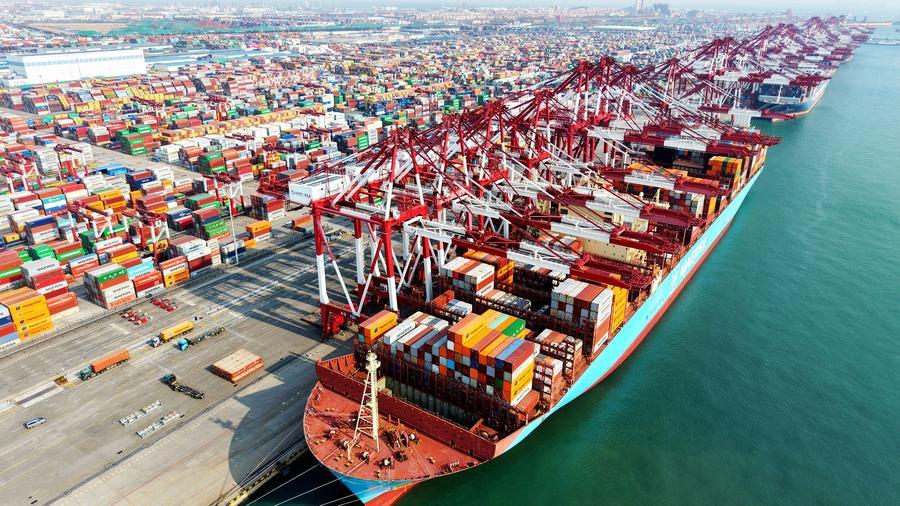
An aerial drone photo taken on March 10, 2026 shows a view of Qingdao Port in Qingdao, east China's Shandong Province. (Photo by Yu Fangping/Xinhua)
"For China's partners, this means vast prospects not only in e-commerce or IT services but also in the collaborative digitalization of the real economy -- encompassing transport, logistics, industry, urban infrastructure, and energy," the expert said.
The document also put forward measures for high-standard opening-up, such as promoting wider opening with regard to telecommunications, the internet, education, and other sectors, shortening the negative list for foreign investment, and ensuring national treatment for foreign-funded enterprises.
"China is expanding opening-up at the institutional level. This is particularly valuable for international partners because the country is not merely creating temporary incentives, but rather a broader and more predictable environment for long-term presence," the expert noted.
Gasimov also spoke highly of China's role as a vital stabilizer for the global economy.
"The 15th Five-Year Plan presents the world with the opportunity not just to trade with China, but to build a new growth architecture alongside China -- one that is greener, more digital, and more mutually beneficial," he said.
The document also underscored the importance of pursuing the Global Development Initiative, the Global Security Initiative, the Global Civilization Initiative, and the Global Governance Initiative, making China's contribution to the building of a community with a shared future for humanity.
Gasimov commended China's actions in promoting the visions, calling them some of the most significant and constructive practices in contemporary global politics.
He noted that the vision of building a community with a shared future for humanity proposes a logic of inclusion rather than exclusion, and win-win cooperation rather than a zero-sum game.
"China is consistently transforming its development into an anchor of international stability, while turning its initiatives into platforms for joint development. In today's turbulent global landscape, this undoubtedly deserves high praise," Gasimov said.■
编辑:韩睿