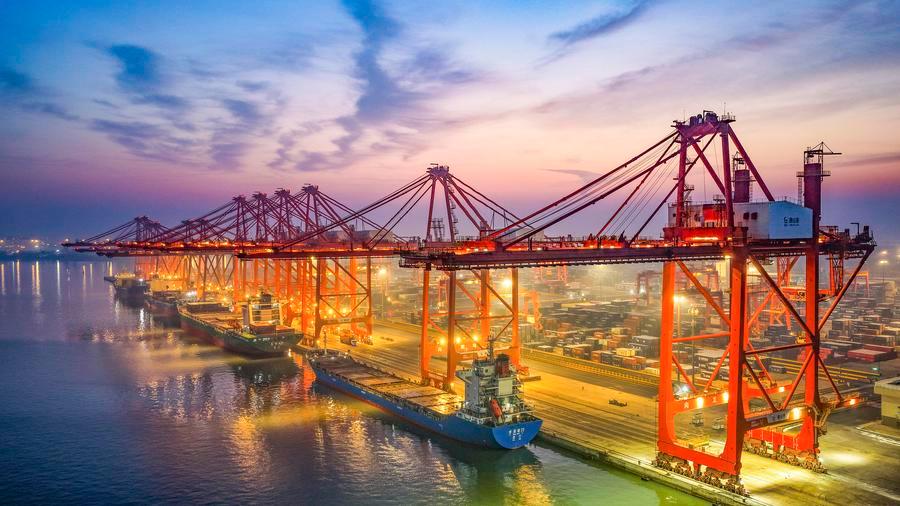
An aerial drone photo taken on Dec. 15, 2025 shows vessels loading and unloading containers at a container dock of Tangshan Port in Tangshan, north China's Hebei Province. (Photo by Liu Mancang/Xinhua)
by Xinhuanet writer Lyu Hui
BEIJING, Feb. 6 (Xinhuanet) -- Despite escalating global trade tensions and mounting domestic challenges in 2025, China's economy has pressed ahead under pressure and advanced toward new and higher-quality growth.
The world's second-largest economy saw its gross domestic product (GDP) grow by 5 percent to reach a record of 140.19 trillion yuan (about 20.01 trillion U.S. dollars) last year, bringing the 14th Five-Year Plan (2021–2025) to a successful close and laying a solid foundation for the 15th Five-Year Plan (2026-2030).
In a world marked by growing turbulence and profound changes, China's resilience, innovation-driven vitality and commitment to openness have not only anchored its own development, but injected sustained certainty into a volatile global economy.
Resilience: stabilizing anchor for the global economy
Amid intertwined risks and challenges, the resilience of China's economy is underpinned by distinctive institutional strengths and inherent advantages, including a vast market, a comprehensive industrial base, and abundant talent resources. These strengths have enabled the country to emerge as an "oasis of certainty" in a turbulent global landscape.
The long-term five-year planning, combined with proactive and effective macro policies and targeted fiscal and monetary measures, has helped China offset external shocks and stabilize its development.
As the only country in the world with all industrial categories listed in the United Nations Industrial Classification, China offers a steady supply of high-quality, cost-effective products, playing an important role in safeguarding the stability of global industrial and supply chains.
At the core of the resilience lies China's vast consumer market with over 1.4 billion people and a growing middle-income group. In 2025, total retail sales of consumer goods reached 50.12 trillion yuan (about 7.15 trillion U.S. dollars) and the contribution rate of final consumption expenditure to economic growth stood at 52 percent.
Consumption played a more pronounced "ballast" role as the country shifted toward making domestic demand the main engine and stabilizing anchor of economic growth, a move analysts describe as a buffer against rising external uncertainties.
Expanding domestic demand has been identified as the top priority task for China's economic work in 2026, which promotes a better match between supply and demand.
Beyond policy and market scale, the ingenuity and grit of the Chinese form the bedrock of the economy, as the country's advantage is evolving from a ”population dividend” to a “talent dividend.”
As China enters the first year of its 15th Five-Year Plan, its development is focused on strengthening underlying stability and balance. Policymakers prioritize expansion of domestic demand, strategic investment in human capital, and fostering innovation to build intrinsic stability for high-quality development.
Innovation-driven development: a new engine for future growth
True resilience lies not only in the ability to absorb shocks, but also in the capacity to break new ground through innovation and improve quality through transformation.
Shifting from the "world factory" to a tech innovation hub, China is accelerating the development of new quality productive forces and moving from quantity-driven expansion to quality-led growth.
Across the country, traditional industries are undergoing a technology-driven transformation to enhance productivity and open new paths for development.
"New trio" products, including new energy vehicles, lithium-ion batteries, and photovoltaic products are moving China's manufacturing sector up the value chain while making it more intelligent and greener. Meanwhile, emerging sectors such as robotics, artificial intelligence and innovative pharmaceuticals are opening up new development frontiers.
China's innovation capacity keeps rising. In 2025, the country entered the top 10 of the Global Innovation Index and achieved an R&D spending intensity of 2.8 percent, surpassing the average level of OECD countries.
During the 15th Five-Year Plan period, China will increase R&D investment, strengthen its innovation ecosystem, advance emerging and future industries, and deepen the integration of technology with industry to foster new quality productive forces.
For multinational corporations, a presence in China is no longer about market access, but about tapping into its innovation capacity to strengthen global competitiveness. British pharmaceutical giant AstraZeneca's new global R&D center in Beijing reflects the shift.
Commending China's transition from high-speed to high-quality development, Maroun Kairouz, managing director of the World Economic Forum (WEF), said that China's structural reforms not only strengthen its own economic resilience but also create new global opportunities in clean energy, technology and trade for 2026 and beyond.
High-standard opening up: turning certainty into shared opportunities
China's resilience is not built on inward-looking development, but on openness and cooperation. At a time when unilateralism and protectionism are on the rise, China has remained committed to high-standard opening up, translating domestic stability into shared opportunities for the world.
During the 14th Five-Year Plan period (2021-2025), China contributed around 30 percent of global growth, reinforcing its position as a stabilizing force in the world economy. Its super-large market and growing consumption potential will continue to generate enormous import demand, creating broad opportunities for countries and regions worldwide.
China has become the major trading partner of more than 160 countries and regions. In 2025, total goods imports reached a historic high of 18.48 trillion yuan (about 2.64 trillion U.S. dollars), cementing its status as the world's second-largest import market for 17 consecutive years.
Concrete steps, including launching the island-wide independent customs operations at the Hainan Free Trade Port, shortening of the negative list for foreign investment access, eliminating foreign investment restrictions in manufacturing, establishing pilot free trade zones and expanding visa-free access, underscore China's commitment to opening up wider to the world.
By expanding institutional opening up and aligning domestic rules and standards with high-level international economic and trade norms, China is fostering a more market-oriented, law-based and internationalized business environment, encouraging multinational companies to deepen their presence in the country.
This openness is reflected in growing foreign investment. PHINIA Inc., a global leader in fuel systems, has invested over 500 million U.S. dollars over the past decade in Yantai, Shandong Province. Other global companies, including Apple, Goldman Sachs and Pfizer, have also reiterated their commitments to the Chinese market, underscoring confidence in the country's long-term economic prospects.
As Stephen Perry, president emeritus of Britain's 48 Group, has observed, China's approach to globalization focuses on building networks and expanding market access rather than erecting barriers.
As China enters the 15th Five-Year Plan period, the underlying conditions and fundamental trends sustaining its long-term economic growth remain unchanged. Backed by a robust domestic market, constant industrial and technological upgrading, a deepening green transition and expanding high-level opening up, China stands well positioned to maintain stable development, as well as to serve as a stabilizing anchor and driving force for the global economy.
编辑:王瑜