
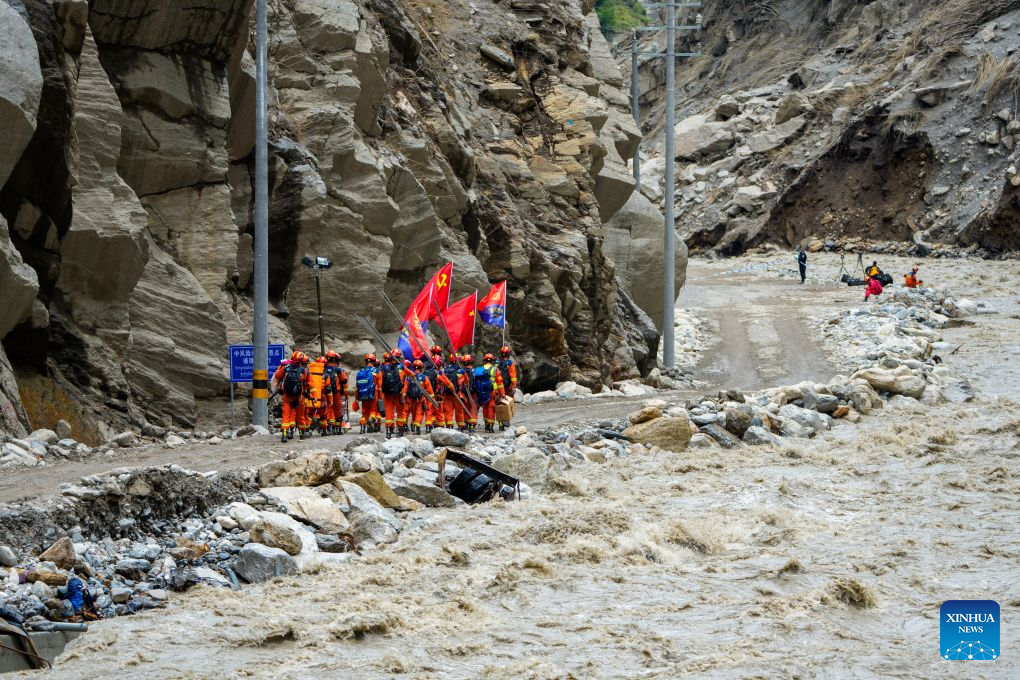
Rescuers walk towards the core area of the mudslide-hit Gyirong Port in Southwest China's Xizang autonomous region, Sept 2, 2026. [Photo/Xinhua]
On Aug 26, a catastrophic glacial debris flow roared down the valley along the China-Nepal border, ruthlessly destroying the Gyirong — Rasuwa border point and shattering any complacency about nature's stability.
The Nepal Police said on Wednesday that the death toll in Nepal from the deadly mudslide has risen to 1,118, with 4,858 people still missing.
Each number represents broken families and lives cut short. While this is a tragedy for both China and Nepal, its repercussions are felt across the Himalayan region and beyond.
We must first confront a fact that some Western media are either ignoring or maliciously distorting: this disaster is not a result of so-called "infrastructure issues" or insufficient information sharing, but a consequence of glacial system destabilization driven by climate change.
According to joint assessments by Chinese and Nepali experts and official agencies, the direct cause was a glacial fracture at approximately 5,200 meters on the northern slope of Langtang Lirung in Nepal.
This triggered a high-altitude ice-rock avalanche, which morphed into a massive debris flow that swept roughly 22 kilometers before hitting the Chinese border port. In the face of major disasters, we firmly oppose any groundless and malicious speculation.
Such rhetoric not only defies science but also shows profound disrespect for the people suffering on both sides.
This tragedy is a stark warning of a "loosening cryosphere." Nepal lost nearly a third of its ice mass in just over 30 years, according to United Nations Secretary-General Antonio Guterres.
The frequency of global glacier instability events has jumped from an average of 3.4 per year (1960-79) to 16.3 per year (2000-19).
The chain reaction at Gyirong — from glacial collapse, slope scouring, to a transnational debris flow — is no longer a distant concept but a harsh reality of a critical system nearing its tipping point due to prolonged warming. It reminds us that the consequences of climate change are not gradual but can trigger devastating, cascading catastrophes.
In this cross-border crisis, China has demonstrated its commitment as a responsible major country and a good neighbor. While conducting emergency response at the Gyirong port, China promptly provided emergency cash and humanitarian supplies to Nepal.
Chinese aid has arrived in Kathmandu, tunnel rescue experts are on the ground, and critical data including satellite imagery and hydrological information have been shared. This is not an isolated act. China has long contributed to Nepal's development through projects like the Upper Marsyangdi A Hydropower Station and has provided vital assistance during major earthquakes and floods. These actions are a testament to the "friendship across the Himalayas" and a concrete embodiment of China's vision for a "community with a shared future for humanity" and South-South cooperation.
However, while both nations are united in rescue and recovery, some Western media outlets have attempted to politicize this natural disaster with irresponsible accusations.
We urge these media to abandon their Cold-War mindset and ideological biases and immediately cease such unconstructive behavior.
Instead of making baseless claims about the relief efforts of China and Nepal, they should focus their energy on pressuring their own governments to fulfill long-standing climate finance commitments.
Under the Paris Agreement, developed nations are obligated to support developing countries in their climate response. Yet, for more than a decade after the pledge was made in 2009, the annual $100 billion target was unmet. While it was reached in 2022, it remains structurally problematic.
With global climate finance needs now estimated in the trillions annually, the recent commitment by developed countries to increase their contribution to $300 billion by 2035 remains far short of the actual demands of developing nations and lacks a clear mobilization path.
The concept of a "community with a shared future for humanity" is not an empty slogan. When the glaciers of the Himalayas begin to destabilize, no country can remain an island. This disaster is a wake-up call from nature to all humanity. We call on all nations, especially developed countries, to confront climate change as a critical nontraditional security threat, shoulder their historical responsibilities, and provide developing countries with large-scale, predictable, and accessible climate finance and technology.
Simultaneously, the international community must accelerate the establishment of a transnational monitoring and early warning system for high-altitude disasters to collectively address emerging challenges like glacier instability.
A truly multipolar world should not be defined merely by a redistribution of power but by the solidarity and cooperation of all nations in tackling shared existential threats.
To awaken from the "loosening cryosphere" and move forward in "shared future" — this is perhaps the most profound lesson from this tragedy and the only viable path toward a sustainable and peaceful future for all.
The author is a Central Committee member of the Nepali Communist Party and former general secretary of the Nepal Communist Party (Maoist Centre).
The views don't necessarily reflect those of China Daily.
编辑:呼乐乐