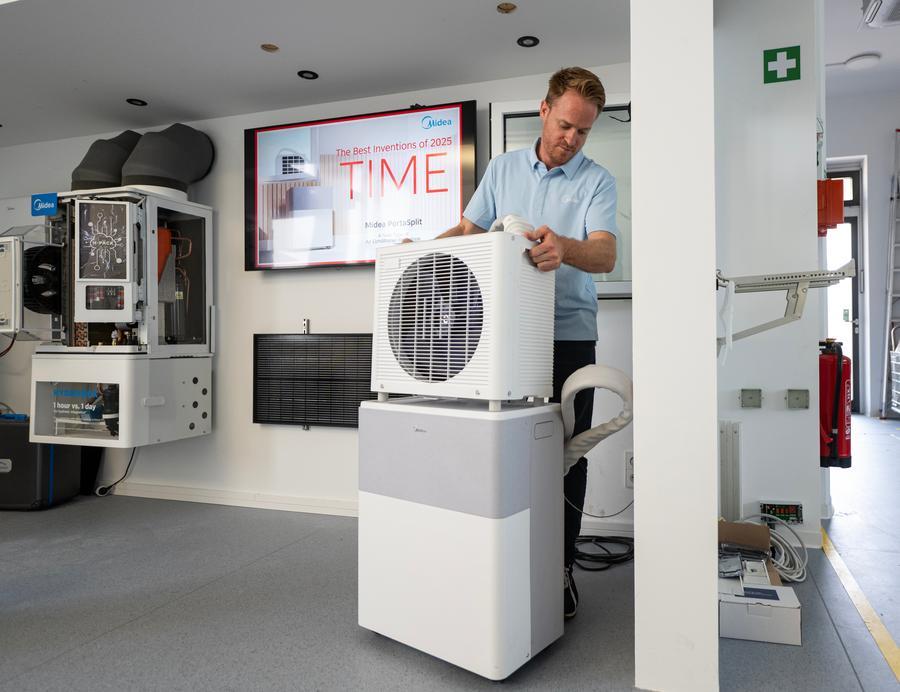
Tobias Strobel, head of technical innovation for residential air conditioning at Midea's German R&D Center, introduces the installation of Midea's PortaSplit mobile split air conditioner in Stuttgart, Germany, June 30, 2026. (Xinhua/Zhang Haofu)
BEIJING, July 8 (Xinhua) -- As record heatwaves scorch Europe, China-made air conditioners and affordable cooling solutions have become runaway bestsellers, offering a timely reminder that China's strong manufacturing capacity is not an "overcapacity" problem at all. It is a solution to real-world needs.
Recently, some European politicians have been weighing up the use of new trade-defense tools targeting what they call China's "subsidized overcapacity." Yet in the marketplace, consumers are scrambling for Chinese products that are affordable, reliable and readily available, voting with their wallets.
The lesson is straightforward. Production that responds to real needs is not "excessive." It is valuable.
This exposes the flaws in the "China overcapacity" narrative. In economic terms, overcapacity should be judged by persistent underutilization, excess inventories, weak profitability and the absence of market demand, not by whether a country's products are competitive enough to be exported.
The Western narrative is clearly rooted in blatant double standards. When European aircraft, automobiles, pharmaceuticals and wine sweep global markets and dominate export shares, they are hailed as Europe's "competitive advantage." However, when Chinese products satisfy global demand, they are unfairly branded as evidence of "overcapacity."
Few in the West complained about "overcapacity" when European countries were urgently seeking Chinese masks and medical supplies during the COVID-19 pandemic. This selective, self-serving rhetoric lays bare nothing but protectionist bias and a zero-sum mentality.
It is worth noting that China's industrial competitiveness comes from fierce market competition, continuous technological innovation, the world's most complete industrial chain, and economies of scale enabled by its super-sized domestic market.
The hype around "China overcapacity" reflects, at its core, the West's overblown anxiety, fueled by its weakening industrial competitiveness, growing pains in energy transition and misplaced geopolitical distrust.
Resorting to trade barriers will not fix the West's structural problems -- it will only backfire. Restricting affordable imports from China will directly drive up living costs for already inflation-hit Western households, deepen hardship for vulnerable groups, and raise the overall cost of the West's green transition.
In the long run, protectionist measures will disrupt global industrial and supply chains, harm the interests of Western enterprises that have long reaped huge benefits from the Chinese market, and ultimately undermine the competitiveness of the West's own industries.
Trade with China should be the natural result of market demand and complementary advantages. It delivers tangible benefits to both sides, with consumers able to gain access to affordable, high-quality products, while enterprises earn reasonable profits. It is a mutually beneficial choice rather than the one-sided "flooding" of goods that some Western politicians claim.
As global warming intensifies, demand for air conditioning and other cooling solutions across European markets is projected to continue its upward trajectory. Chinese enterprises have secured a competitive edge in both production capacity and technological innovation for such products. For European policymakers, rushing to erect fresh trade barriers targeting Chinese products will deprive local consumers of a more affordable escape from the sweltering summer heatwaves that have repeatedly hit Europe in recent years and are likely to continue. In worst cases, it may cost European lives.
In the beginning of its reform and opening-up drive, China had no hesitation at all in embracing investment and advanced technology from Europe, which played a valuable part in China's development and prosperity.
Today, it will be wise for European policymakers to encourage Chinese air-conditioner makers to bring their investment and technology to Europe, including in the form of joint ventures with European partners to realize localized production and joint technological R&D development. Such cooperation will bring win-win results for both sides, and a relief for Europeans struggling in the heat wave.
编辑:呼乐乐