
A job seeker talks with a recruiter at a job fair on Songjiang campus of Shanghai University of Engineering Science in Shanghai, April 9, 2026. [Photo/Xinhua]
In recent years, Western discourse has increasingly framed Chinese youth through a lens of economic despair, portraying them as a demographic burdened by urban living costs, supposedly forced to forgo their futures. By selectively amplifying the short-term pressures faced by a minority in China's first-tier cities, this narrative marginalizes the dynamic social mobility and development resilience inherent in Chinese society.
Rents consuming half of one's income, cramped apartments shared with strangers and grueling hours spent in overcrowded subways — this is the image of Chinese youth often projected by viral social media videos. While these snapshots capture real pressures, they offer a fragmented view rather than a comprehensive reality of China.
Data from Beike Research Institute reveals a more nuanced picture: During the graduation season, the rent-to-income ratio in first-tier cities averaged 39.23%, but dropped significantly to 24.09% in new first-tier cities and 22.58% in second-tier cities.
In these emerging hubs, the balance between living costs and earnings remains well below the internationally recognized 30% warning threshold. Furthermore, the expansion of government-subsidized rental housing has provided a vital buffer for fresh college graduates and new urban residents.
The narrative around commuting is similarly skewed — according to the China Academy of Urban Planning and Design, 77% of commuters in major Chinese cities reached their destinations within 45 minutes in 2023. Supported by the world's most extensive subway network, China's urban infrastructure continues to prioritize efficiency over the "endless" travel times often cited in Western commentary.
Characterizing China's youth as "a generation quietly giving up" is also a profound misunderstanding of their development resilience. In reality, the "lying flat" rhetoric found online serves primarily as a psychological release valve rather than a definitive behavioral shift. Statistics and social trends indicate that young Chinese have not ceased their pursuit of progress; instead, they are proactively optimizing their career trajectories.
Many are moving beyond the saturated competition of first-tier cities to find more abundant opportunities in emerging new first-tier and second-tier cities. Others are choosing to devote themselves in rural revitalization, leveraging the nation's robust digital infrastructure to pioneer new economic frontiers through e-commerce and livestreaming. These shifts are not the "compromise" often depicted in Western commentary; rather, they are sophisticated adaptation to a changing economic landscape — a testament to a generation that is not sinking, but striving.

Zhu Jun (left), head of a shared vegetable garden, guides visitors through hands-on agricultural work in a field in Fengqiao town, Nanhu district of Jiaxing city, Zhejiang province, April 8, 2026. [Photo/Xinhua]
The assertion that China's working-class youth are facing "immovable ceilings" — as portrayed in Western media outlets like the New York Times, fails to grasp the structural shifts of the nation's economic transformation. Such a perspective disregards the new opportunities emerging from China's high-quality development as well as the strong foundation for youth growth established by China's poverty alleviation campaign. Over the past four decades, China has lifted nearly 800 million people out of poverty, accounting for 75% of the world's total poverty reduction during this period. This unprecedented milestone in human history has done more than just improve living standards; it has fundamentally paved the way for upward mobility, ensuring that young people from even the humblest backgrounds can realize their dreams.
Rural youth, once constrained by poverty, are now leveraging education and vocational training to access equal opportunities for advancement. Education remains a vital ladder for social mobility, with university enrollment for this generation now far exceeding that of their parents. Simultaneously, the rise of specialized vocational education has enabled skilled workers to earn competitive monthly salaries exceeding 10,000 yuan.
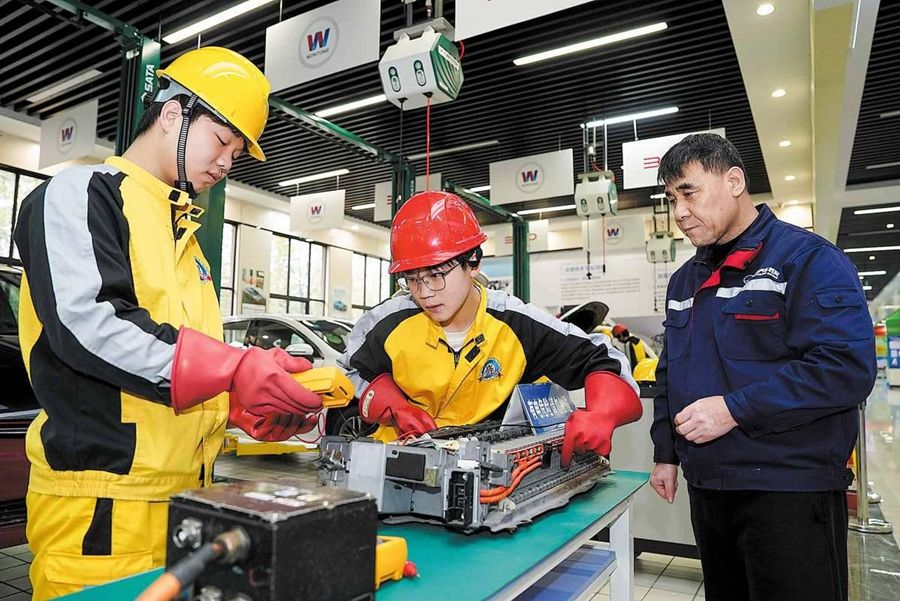
Wang Wentao (left) and Zheng Piaoxue (center) learn how to measure the voltage of a new energy vehicle battery at a training center in Hefei, Anhui province, December 2024. [Photo/Xinhua]
According to estimates by Zhuo Xian, a researcher at the State Council's Development Research Center, China's digital economy now supports nearly 200 million jobs, representing one-quarter of the national workforce. The expansion of digital platforms and e-commerce has been particularly transformative for rural development. Studies show that over 80% of emerging digital professions are now concentrated in third-tier cities and rural regions.
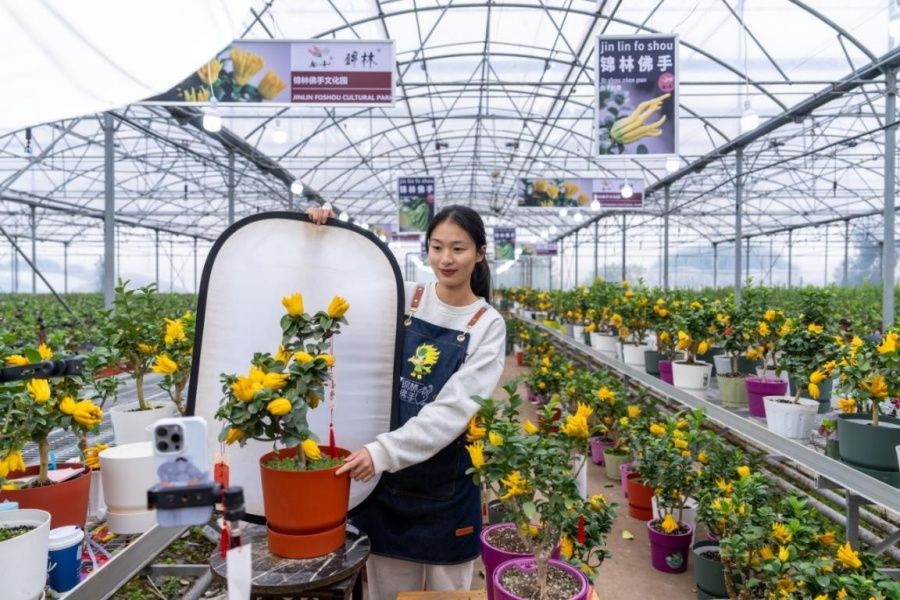
An agricultural innovator sells bonsai via livestream in a greenhouse in Jindong district of Jinhua city, Zhejiang province, Dec. 9, 2024. [Photo/People's Daily Online]
As China's economy continues to evolve, a significant shift toward high-quality growth is taking place. The service sector now accounts for over 48% of total employment, and is projected to reach approximately 55% over the next four to five years, thereby becoming the primary engine for job creation.
At a press conference on the sidelines of the Fourth Session of the 14th National People's Congress on March 6, Zheng Shanjie, head of the National Development and Reform Commission, stated that China's manufacturing and service sectors are poised to see a combined growth potential exceeding 40 trillion yuan (about $5.8 trillion) during the 15th Five-Year Plan period (2026-2030), creating an estimated 10 million-plus new jobs annually.
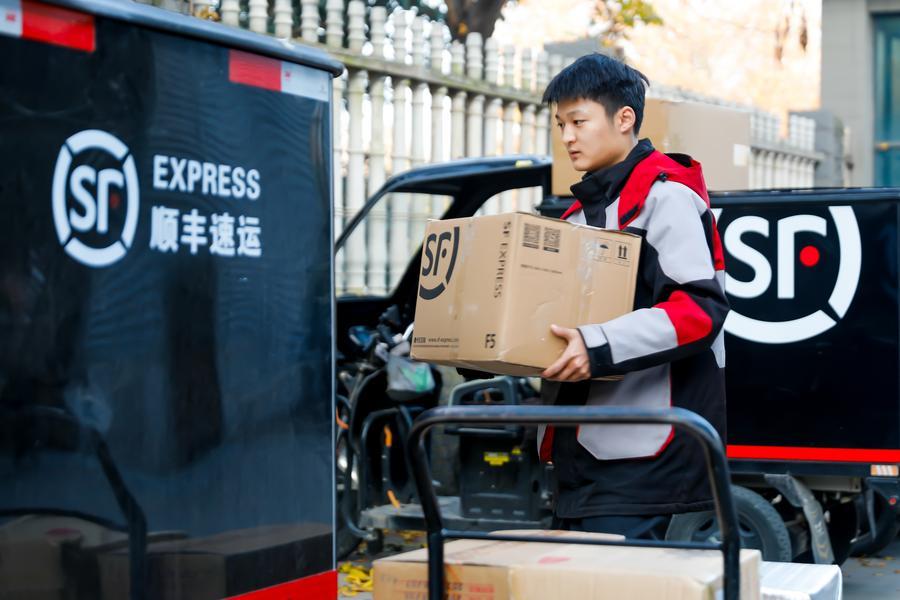
A deliveryman carries a package at a branch of courier service provider SF Express in Wuzhi county, Henan province, Nov. 11, 2025. [Photo/Xinhua]
Chinese youth today do face significant challenges and competition, but these are the natural friction of rapid development, not a terminal crisis. The truth is that young Chinese have never stopped striving, nor have their doors to upward mobility been shut. As affordable housing initiatives scale up and regional growth becomes more balanced, the opportunities for the average young person to rise and succeed are set to become even more accessible.
Li Dazhao, a renowned Chinese intellectual and communist, once said, "The youth are the soul of a country." Today, China's youth are dedicating themselves to the great undertaking of Chinese modernization — fulfilling their personal aspirations amid the surging tides of national rejuvenation.
编辑:韩睿