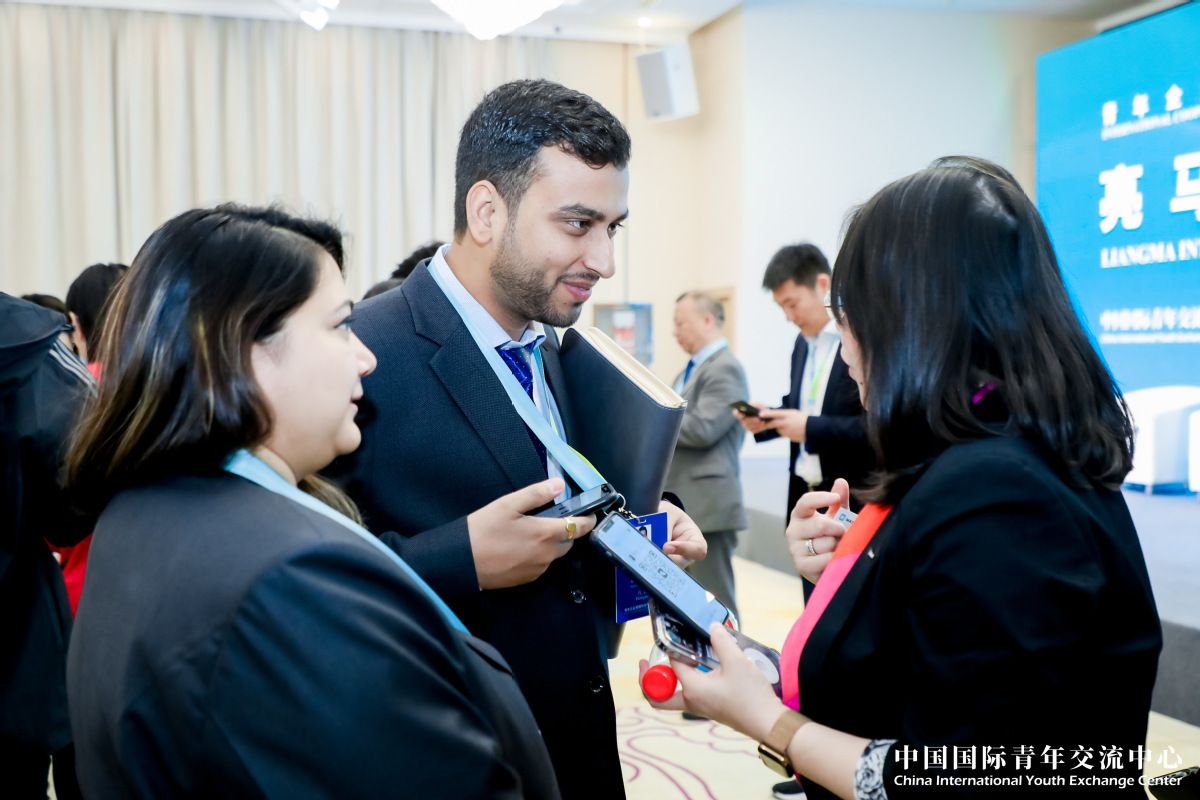
Attendees are seen in discussion during the International Cooperation and Development Conference for Young Entrepreneurs in Beijing on April 26, 2023. [PHOTO/CHINA DAILY]
Severing economic ties with China is unrealistic, and no multinational company can leave the country's flexible and resilient supply chains if it seeks long-term development, industry experts and top executives of multinational companies said.
Ola Kaellenius, CEO of German carmaker Mercedes-Benz, told newspaper Bild am Sonntag on Sunday that decoupling from China is "unthinkable" for almost the entire German industry.
"The major players in the global economy, (including) Europe, the United States and China, are so closely intertwined that decoupling from China makes no sense," he said, adding that attempting to do so would put a majority of German companies at risk.
For Mercedes-Benz, China was the most important global market last year, with a 37 percent market share in car sales, data from the company shows. In contrast, Germany and other European markets accounted for 31 percent while the US only made up 15 percent.
"Our sales figures in China are increasing and I am quite optimistic that we will grow this year, too," he said.
Kaellenius joins a large group of industry captains who have turned down calls to reduce deep dependency on China and emphasized their unwavering commitment to the world's second-largest economy.
Ueda Toshihiro, vice-president of the Japanese Chamber of Commerce in China, told China Daily that "it is impossible for Japanese multinationals to decouple from China as many of its supply chains have been established for three to four decades".
Ueda, who is also executive director of leading Japanese glass and consumer electronics manufacturer AGC Co, noted that China's role is changing on the global stage — from the world's largest consumer market to a powerhouse of scientific innovation.
"Such a change enables us to build a wider supply chain, including material purchasing, production and sales — all in China. Now, AGC has established its own research and development and technology centers in the country," he said.
According to Ueda, for multinationals to establish a well-rounded global industrial chain, "open" is the keyword. "Companies should find their strengths and complement each other's advantages for better growth," he added.
Xu Gang, CEO of aerospace giant Airbus China, also gave a vote of confidence to China's supply chains by emphasizing that they have been very "flexible".
"Even with the COVID-19 pandemic, Chinese suppliers didn't experience substantial disruptions or postpone deliveries," Xu told China Daily.
"Airbus is fully aware that only with free trade can there be a free flow of resources and the aviation market can develop. Therefore, the company is devoted to developing multilateralism and is against trade protectionism," he added.
According to the Ministry of Industry and Information Technology, China has been the world's largest manufacturing power in terms of industrial output for decades. It is also the only country in the world that has developed all the industrial categories listed in the United Nations industrial classification.
At the China Development Forum in late March, former mayor of Chongqing Huang Qifan said that some countries' calls to decouple from China "would never succeed".
"China has a uniquely massive single market, unified in terms of laws, taxes, business rules and other factors key to economic development," he said.
To explain his point, Huang cited the example of India, which is a potentially larger market than China, but is fragmented. The Indian market is governed by different state-level laws and business rules, he noted.
"Hence, China's single-market advantage greatly lowers costs related to manufacturing, research and development, fixed asset investment, logistics, market development and even raw material procurement. This scale of advantage can help global companies reduce manufacturing costs by 30 to 40 percent," he said.
编辑:张娟