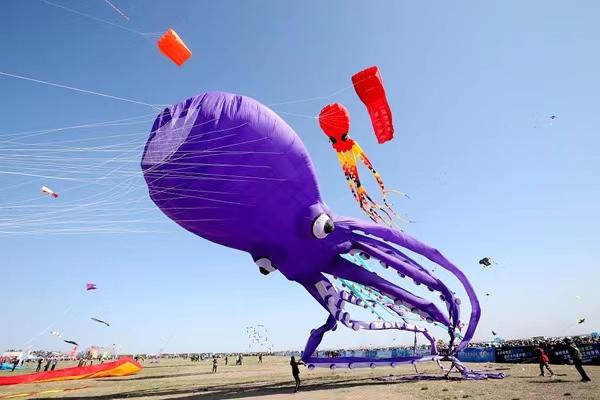
A large octopus kite is flown during the 38th Weifang International Kite Festival in Weifang city, east China's Shandong province, April 17, 2021. [Photo/VCG]
"After-school kids come home early, keen to fly kites while East Wind's spry." This Chinese poem from the Qing Dynasty (1644-1911) indicates the long history and great popularity of flying kites in China.
Known as the "kite capital" of China, Weifang city in east China's Shandong province has a long history of making kites. Guo Hongli, from Weifang's Hanting village, is now a representative for Weifang kites, which were included on the first national-level intangible cultural heritage lists by the State Council in 2006.
A traditional craft refreshed via mobile games
"When I was a kid, I had no toys, so I flew kites that I made by myself to have fun," says Guo, who was born into a kite-making family. He grew up seeing his father and uncles create kites and sell them at fairs. Gradually, he learned to make kites himself.
"My father told me that fashioning kites is a craft that needs tender and delicate attention," says Guo, who is "picky" about which materials he uses as well as the assembly process. "I always go to south China to buy bamboo myself, and the bamboo must have grown for more than five years."
Once a worker in a print shop, Guo quit his job to follow where his true interests lie - making kites. His works take assorted shapes from historical and mythological figures, from animals to cultural relics, and measure in lengths ranging from two centimeters to more than 100 meters.
As a representative of a national intangible cultural heritage, Guo Hongli, while carrying forward the folk handicraft, also delves into kite innovation to attract more young people to this traditional culture. He believes that in the ever-changing internet era, it is essential to actively innovate and integrate with the younger generation.
In 2021, Guo was invited to make a themed kite for Tencent's mobile game, Honor of Kings. He used a novel technique to build the structure and applied elements of nine-colored deer and flying apsaras - both motifs featured in the Dunhuang murals and caves - in his designs, giving the kite a mixture of tradition and modernity. Guo also introduced the history and production process of Weifang kites via an online livestream, with viewers peaking at 6.5 million. Similarly, back in 2019, Guo also designed a kite as a prop for the mobile game Perfect Word.
Guo Hongli believes that the traditional essence of making kites must be inherited while pursuing innovations. "Effective innovation is impossible without a good take on traditional techniques," he says.
Bringing local art to a bigger stage
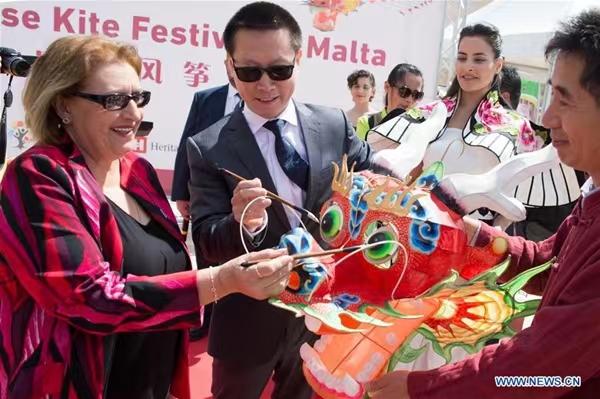
Guo Hongli (R) draws eyes on a dragon kite for Marie-Louise Coleiro Preca (L), the then Maltese president, in Valleta, capital of Malta, May 17, 2019. [Photo/Xinhua]
Guo has continued to hone his skills and win honors throughout his 30-plus years of career. His work "Centipede with a Dragon Head" won the gold medal in the first China Intangible Cultural Heritage Expo in 2010. His kites were also showcased in the cultural exhibitions of the 2008 Beijing Olympic Games and the 2011 Shanghai World Expo. Currently, Guo is credited with more than 10 patents relating to kite creation.
In addition to domestic cultural exchanges, Guo has been to more than 30 countries and regions to spread the word on Chinese kites, bringing this traditional craft to the world. In addition, the Ministry of Culture and Tourism (MCT) has presented his works as gifts to more than 170 institutions stationed abroad.
In 2018, Guo brought his kites to Malta under the auspices of the MCT for various cultural exchanges. Afterward, the then Maltese president Marie-Louise Coleiro Preca especially lauded Weifang kites and decided to organize an annual Chinese kite festival in Malta going forward.
A traditional industry eyes new opportunities
Since the first Weifang International Kite Festival was held in 1984, the city's kite industry has flourished.
According to Zhang Jianwei, director of the Weifang International Kite Association Comprehensive Service Center, there are now more than 600 kite enterprises in Weifang. Currently, the industry chain is believed to provide 80,000-plus jobs, while related industries generate an annual output of more than two billion yuan. The city is also home to 39 kite exporting companies, with wares exported to more than 50 countries and regions worldwide, occupying 85% of the international market share.
In recent years, Weifang's kite industry has ridden the e-commerce wave in China. Many businesses have moved online, and daily turnover from online livestreams sometimes can exceed 390,000 yuan.
Be it technique innovation or marketing transformation, Guo's overall goal is to carry forward this traditional folk art. "Kites are rooted in Weifang. As an inheritor of this craft, I hope to pass it on and promote Weifang kites on the international stage," Guo says.
编辑:胡一瑾